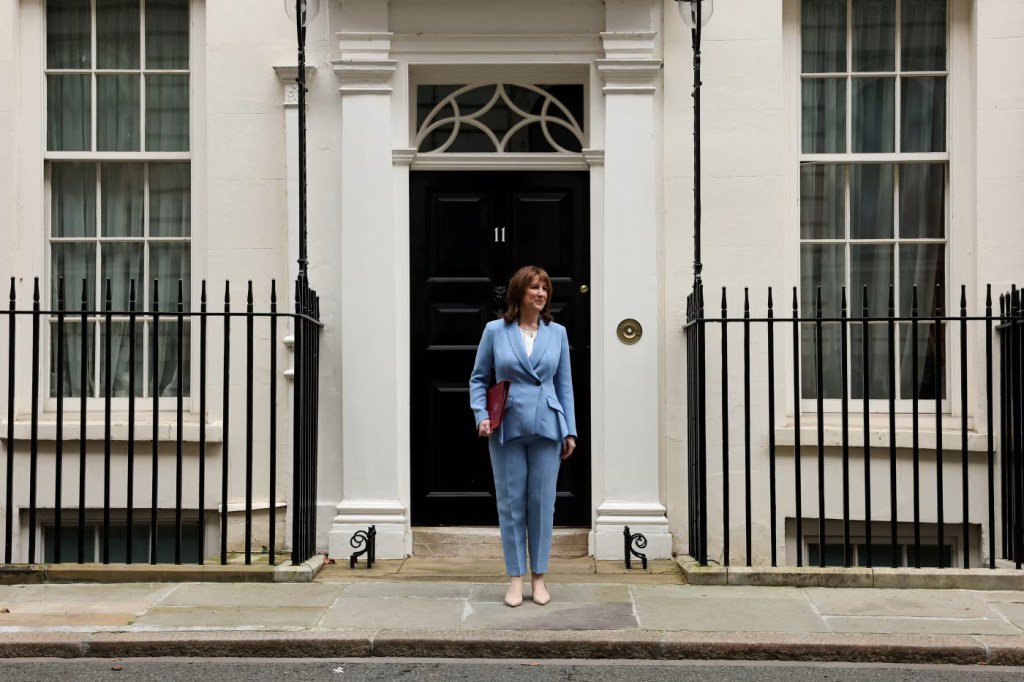
The U.K. government is on track to cut borrowing and reduce its debts, although the attacks on Iran by the U.S. and Israel have made the outlook more uncertain, Treasury Chief Rachel Reeves said Tuesday.
In the first of two annual presentations to lawmakers, Reeves cited new forecasts from the Office for Budget Responsibility that estimate the budget deficit for the fiscal year ending early next month will be 4.3% of annual economic output, the smallest gap between expenditures and revenues since the outbreak of the Covid-19 pandemic.
“The forecasts today confirm that the choices this government has made are the right ones,” Reeves said. “Stability in our public finances, interest rates and inflation falling.”
However, Reeves said the economic outlook has become “yet more uncertain” after the attacks on Iran and its response.
“It is incumbent on me and on this government to chart a course through that uncertainty, to secure our economy against shocks and protect families from the turbulence that we see beyond our borders,” she told lawmakers.
The conflict has raised energy prices, potentially slowing U.K. growth and pushing consumer prices and borrowing costs higher.
“If it persists, it will raise household bills and business costs in the months ahead, putting renewed upward pressure on inflation, and potentially interest rates,” said David Aikman, director of the National Institute for Economic and Social Research.
Even before the attacks, the outlook for the U.K. economy had weakened. The OBR lowered its growth forecast for 2026 to 1.1% from 1.4%.
The OBR’s estimate for this year’s budget deficit is lower than the 4.5% it saw in November. It expects the deficit to fall to 3.6% of economic output in the coming fiscal year, and 2.9% in the following period.
The OBR’s new forecasts indicate that the government is sticking to its self-imposed budget rules, which require that day-to-day spending is paid for out of tax revenues, rather than borrowing, by the fiscal year ending March 2030.
The budget watchdog estimated that in that year, the current budget will be in surplus by 23.6 billion pounds.
The budget rules also require that the stock of debt—measured as public sector net financial liabilities—should be falling by the fiscal year ending in 2030. The OBR estimated debt would be equivalent to 82.2% of economic output in that year, down from 82.9%.
Better news on the deficit had helped lower government bond yields following the November budget. That was helped by expectations that the Bank of England would lower its key interest in the first half of this year.
Over time, lower yields would have translated into reduced interest bills. But much of that progress has been unwound since the attacks on Iran began.
The BOE had expected inflation to settle at its target from April, but higher energy prices raise doubts about that projection. Policymakers may become more cautious, and reluctant to lower borrowing costs until they can be more certain of the likely impact of the new shock.
There is therefore a risk that economic growth and government tax revenues will be lower than the OBR expects, while the interest bill will be higher.
“The conflict in the Middle East has changed the outlook,” said Paul Dales, an economist at Capital Economics. “There is a real risk that government borrowing will be higher.” https://www.wsj.com/economy/u-k-government-sees-debt-plan-on-track-but-flags-fresh-uncertainty-dc54247b?mod=global_news_article_pos5

 2026NowNews