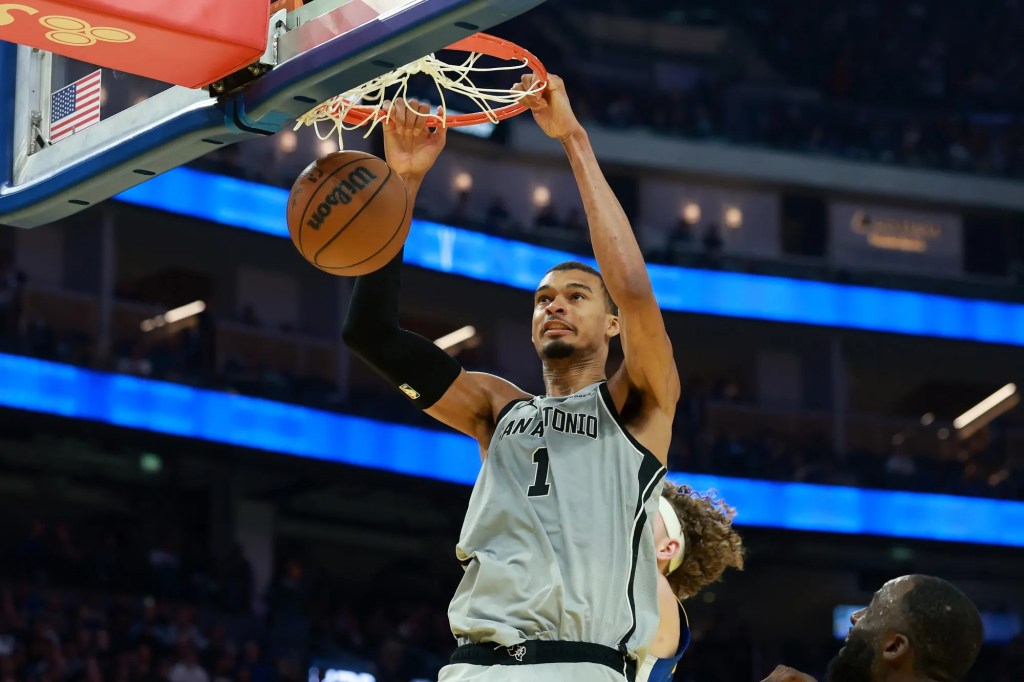
What stands out most about San Antonio Spurs’ Victor Wembanyama in his National Basketball Association playoff debut on Sunday night might not be how he plays, but who has to stay up to watch. Tipoff will land in prime time, at 8 p.m. CDT, for American viewers. In France, where he’s a national icon, that’s 3 a.m. Monday, forcing his most devoted fans to work around a schedule built for Texas.
That timing says a lot about how the NBA views its fanbase. The league has spent decades building audiences abroad, but it still saves the biggest moments for viewers in the US. Wembanyama, a 7-foot-4-inch marvel, is making it clear why that America-first approach is a losing strategy.
More people want to see a star who doesn’t fit the traditional positions and roles assigned to players of his size. He’s able to protect the basket and keep up with smaller and faster players on the other team — sometimes in the same possession. On the offensive end, he’s just as versatile, lofting three-pointers and slam dunks. Defenses aren’t designed for that kind of range, and the usual basketball answers — like packing the paint and betting he’ll miss from outside — often break down against him.
Off the court, he’s just as hard to pin down. Where, for example, is Wembanyama’s “home market”? San Antonio? It seems that way on the surface. After he was picked in the 2023 NBA draft, fans bought over 4,000 new Spurs season ticket packages — and that’s before he even played a game.
But his impact on his native France is even more profound. The 2024-25 NBA season was the most-watched ever in his country, and drove a 54% surge in new League Pass subscriptions. Any question about Wembanyama’s role in this growth can be answered by the two 2025 games he and the Spurs played in Paris — the most-watched NBA telecasts in French history.
Those numbers show how narrow the league’s notion of “home” is, compared with the global reach of its newest superstar. In the league, “home” is the city on the jersey and the television market attached to it. Players are drafted, developed and branded in that place, and broadcasts are scheduled for the largest possible US audience. The result is a global household name playing at times that make it difficult for much of his fan base to watch live.
While Wembanyama isn’t the first international star to pose this dilemma, his rise comes as the NBA says its overseas social media followers now outnumber those in the US. Making things even more complicated is the fact that, as I’ve written before, today’s sports fans are increasingly focused on stars, not teams. Ask a Parisian teenager which team they follow, and they are as likely to say “Wemby” — Wembanyama’s nickname — as they are to say the Spurs (maybe more so). Social media and the popularity of short-form content, where individual heroics are emphasized over full games, help drive this shift toward player-first fandom.
That trend is even more powerful in a global league. For example, fans in France often follow French players, regardless of where they play.
The NBA isn’t ignorant of these dynamics, and in recent years it’s taken steps to adapt. This season, Amazon Prime Video signed on as a global partner and featured a slate of Saturday games that streamed during prime time overseas (four of the games featured the Spurs). Meanwhile, commissioner Adam Silver is actively planning NBA Europe, a continental league that would plant a permanent NBA-branded flag there.
If the league follows these developments to their natural conclusions, its geography could start to look very different. Global fans attracted to a star-driven league don’t really care if their favorite player suits up in San Antonio or Sacramento. As their preferences and spending power shape the league, the NBA might consider evolving into a model that more resembles the Premier League and European soccer.
In that system, drafts aren’t used to assign players to teams. Stars choose where to play and gravitate to a few global cities where they can get top dollar. That shift could push the NBA draft — already under pressure because of the practice of tanking — toward irrelevance.
American fans of small-market teams, which rely on the draft to bring in stars, would hate the change — and their interests still carry weight. Local governments that have invested heavily in stadiums and other sports facilities would resist any shift that sidelines their teams, while ticket sales and local sponsorships remain important revenue streams for NBA teams.
But with Wembanyama and a growing cohort of international ballers making the NBA more of a global brand, the league can’t afford to mainly run on American time. https://www.bloomberg.com/opinion/articles/2026-04-19/victor-wembanyama-nba-playoff-debut-challenges-america-first-strategy

 2026NowNews