
HPE’s stock rises as earnings benefit from two big AI trends

Hewlett Packard Enterprise is reaping the benefits of its well-timed Juniper Networks acquisition.

Networking has proven an increasingly hot area as artificial intelligence drives up the need for connectivity technologies. HPE 

HPE+3.22% said on Monday that it saw a 40% bump in data-center switching orders during the latest quarter, along with a mid-20% increase in routing orders.

“Networking now represents a very important component of revenue, but actually an even more significant part of our operating profit,” Chief Financial Officer Marie Myers told MarketWatch, noting that HPE currently gets about 30% of its revenue, as well as half of its operating profit, from networking.

Shares of HPE rose 1.4% in the extended session.

The company on Monday raised its networking revenue guidance for the full fiscal year. HPE now expects 68% to 73% growth, versus a prior projection of 65% to 70% growth. The unit now receives contributions from Juniper’s business, and HPE has been making a push to drive synergies there.

HPE left intact its overall revenue outlook for the full fiscal year, which calls for 17% to 22% growth.

With that, the company is “being prudent,” according to Myers. “We’re at a fairly uncertain time right now.”

HPE increased its full-year outlook for adjusted earnings per share, which now calls for $2.30 to $2.50, compared with $2.25 to $2.40 before. While HPE isn’t immune to the memory-supply crunch, the company has found ways to manage the situation, according to Myers.

She noted that HPE has long-term supply agreements, is making “agile” pricing decisions and is steering customers toward the sorts of configurations that are optimal based on supply availability.

HPE has generally been benefiting from demand for AI servers, although Myers said the company is emphasizing deals that play to its strengths — namely to sovereign and enterprise customers. Enterprise AI orders were up “quite significantly” both sequentially and relative to a year before, she said.

“That will continue to be a part of our story, albeit it’ll be somewhat lumpy in the back half of the year,” she added.

In the fiscal first quarter, HPE reported adjusted earnings per share of 65 cents on revenue of $9.3 billion, which was up 18% from a year before. In a release, CEO Antonio Neri said this was one of the company’s “most profitable quarters on record.” Adjusted EPS topped the 59-cent FactSet consensus view, while revenue was a bit below the $9.35 billion that analysts were forecasting.

For the fiscal second quarter, HPE projects 51 cents to 55 cents in adjusted EPS, as well as $9.6 billion to $10 billion in revenue. Analysts were looking for 53 cents and $9.57 billion, respectively. https://www.marketwatch.com/story/hpes-stock-rises-as-earnings-benefit-from-two-big-ai-trends-a3df2732?mod=newsviewer_click
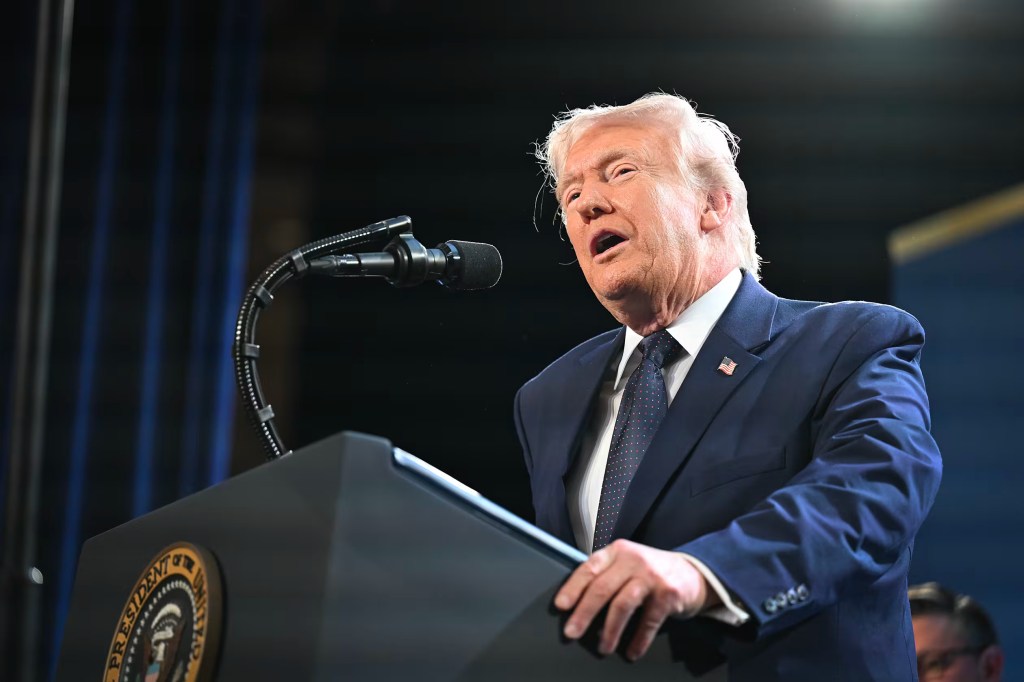
Trump announces sanctions relief to ease oil prices, says Iran war to end ‘very soon’

President Donald Trump said the U.S. is waiving oil-related sanctions on certain countries in an effort to ease crude prices, as he estimated the war with Iran would end “very soon.”

“So in some countries, we’re going to take those sanctions off until this straightens out,” Trump said Monday in remarks to reporters in Doral, Fla.

The president spoke after U.S. stocks 

SPX+0.83%

 staged a comeback and oil prices 

CL.1-7.10%

BRN00-6.99%

 retreated from highs as investors priced in the possibility of a coordinated emergency release of oil reserves. Oil futures were falling another 10% on Monday night.

Trump didn’t name countries on which his administration is mulling the reduction of sanctions. Earlier Monday, Reuters reported that the White House was weighing further easing of sanctions on Russia. The U.S. has allowed India to buy Russian oil without being penalized by the Trump administration. Trump spoke with Russian leader Vladimir Putin on Monday.

Trump predicted a “short-term excursion” in Iran but also suggested U.S. involvement there would continue.

“We could go further, and we’re going to go further,” he said.

Earlier Monday, Trump told a CBS reporter that the conflict with Iran could end soon, saying he thought the war was “very complete, pretty much.” He said Iran has no navy, communications or air force.

And there were signs Monday that the wealthy countries that make up the Group of Seven were discussing an emergency release of crude reserves.

U.S. and global benchmark prices both climbed to nearly $120 a barrel at their peaks in overnight trading, before retreating from those highs as investors priced in the potential G-7 action.

Futures Movers: Oil prices pull back from highs near $120 a barrel on talk of G-7 emergency release of crude reserves

The G-7 development helped ease concerns over disruptions to the global flow of oil resulting from the Iran conflict. Energy ministers from the group are planning a virtual meeting Tuesday to discuss a possible release of oil reserves to address supply disruptions triggered by the Iran war, sources told CNBC.

Oracle faces a high bar for earnings as investors look for an AI payoff

Oracle is pivoting toward cloud infrastructure, and that has proved controversial on Wall Street due to the heavy spending it requires. Can the company sway the doubters with its third-quarter results Tuesday?

Shares of Oracle 

ORCL-0.92% are down 22% so far this year, and they’re off 55% from their September peak. Investor sentiment has remained subdued even as the company announced a $50 billion funding strategy that some analysts thought would remove an overhang around the amount of debt the company will need to take on this year.

Unanswered questions remain regarding Oracle’s ability to execute on AI infrastructure buildouts. Investors are also curious about the ultimate return on investment that will come from all these AI commitments, BNP Paribas global head of software research Stefan Slowinski wrote in a note Friday.

While Slowinski doesn’t expect Oracle’s earnings results to offer definitive conclusions, “we believe simply hitting [fiscal third-quarter] consensus numbers would be a good first step in rebuilding confidence that the company can consistently deliver against expectations,” he wrote. Slowinski maintained his buy rating but lowered his price target to $201 from $290.

Analysts tracked by FactSet are expecting Oracle to report $16.2 billion in sales and $1.70 in earnings per share. Remaining performance obligations, or future revenue not yet recognized, are expected to be $556 billion.

Read: Oracle’s selloff offers a chance to buy an ‘upper-echelon’ growth stock for cheap, analyst says

Last Friday, Bloomberg reported that negotiations for a 600-megawatt expansion at Oracle’s Abilene, Texas, data-center site were canceled due to financing challenges and OpenAI’s shifting needs. However, TD Cowen analyst Derrick Wood wrote in a Monday note that the development could reduce Oracle’s capital-expenditure needs by up to $20 billion in the next few years but not impact Oracle’s RPO, as he believed the deal hadn’t been formally signed.

Oracle has disputed these reports, saying in a statement Sunday that “recent media activity about the Abilene site are false and incorrect.”

Amid AI funding concerns, Oracle is reported to be planning thousands of job cuts as well. Meanwhile, the company is expected have put $14 billion toward capital expenditures in the third quarter, leading to negative free cash flow of $8.1 billion.

Read: Oracle is the canary in the coal mine for Big Tech’s debt-fueled AI spending spree

For Tuesday’s earnings report, Jefferies analyst Brent Thill is focusing on a few key bogeys, or performance benchmarks. These include 86% growth for the company’s Oracle Cloud Infrastructure division, 42% operating margins and $18 billion in net new RPO. However, Thill expects Oracle’s margins to continue declining in the short term as the company’s business becomes more focused on AI infrastructure. He anticipates adjusted operating margins to trough at roughly 33% in fiscal year 2028.

“Overall, we see favorable risk‑reward, with our analysis suggesting the market is assigning negative value to the [OpenAI] deal and the stock already discounting a bear‑case outcome,” Thill wrote in a note last week. https://www.marketwatch.com/story/oracle-faces-a-high-bar-for-earnings-as-investors-look-for-an-ai-payoff-8ecd279e?mod=newsviewer_click