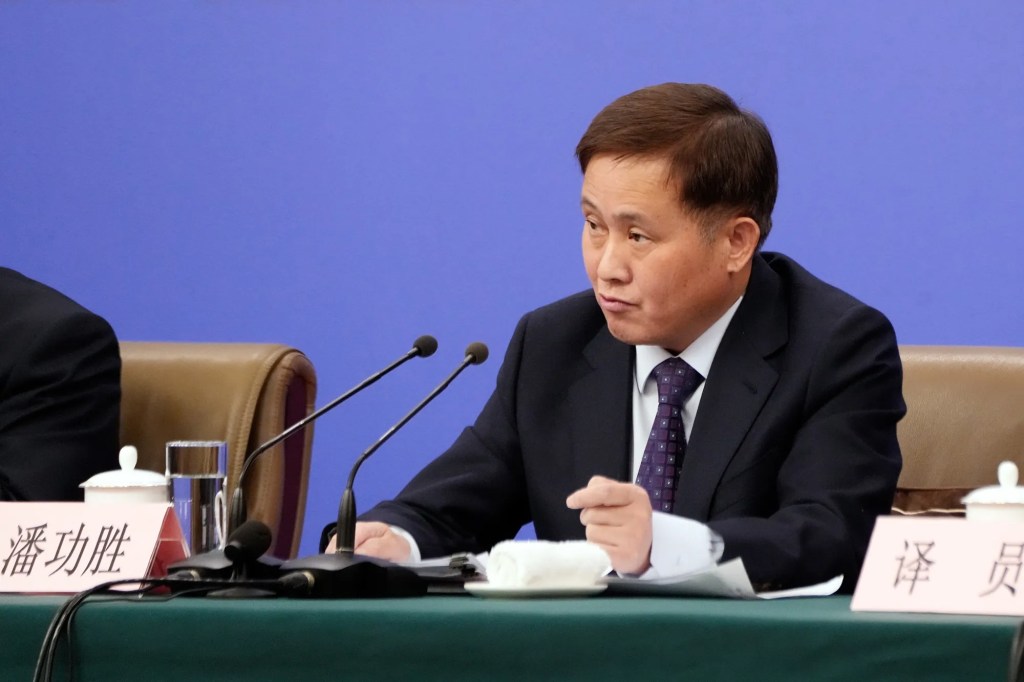
China’s central bank governor Pan Gongsheng said artificial intelligence is driving a new wave of technological and industrial transformation that brings both opportunities and risks to the global economy.
Speaking at an International Monetary Fund meeting in Washington earlier this week, Pan said rising geopolitical tensions, protectionism and trade restrictions are further weighing on global growth and increasing financial market volatility, according to a statement published on the PBOC’s website Saturday.
Pan also called for deeper international policy coordination to safeguard macroeconomic and financial stability and urged countries to uphold multilateralism and free trade.
The remarks came along with meetings this week of major multilateral lenders in Washington, where China’s Finance Minister Lan Fo’an reiterated Beijing’s call for faster World Bank shareholder reform and greater financing for infrastructure and job creation. He also pledged deeper cooperation as China seeks to expand domestic demand and share its development experience with other emerging economies, according to a separate statement on the finance ministry’s website Saturday. https://www.bloomberg.com/news/articles/2026-04-18/china-central-bank-s-pan-flags-ai-risks-opportunities-at-imf?srnd=phx-technology
In ACSI’s results, AI scored an overall customer satisfaction score of 73 on a scale of 0 to 100, which the authors noted was slightly below social media (74), airlines and mortgage lenders, but in line with energy utilities.
The ACSI poll found that 43% of respondents said reduced human-to-human interaction is their main concern, followed by job loss for future generations (37%) and their own job risk (31%), based on interviews with 2,711 US adults.
Baby Boomers were the most skeptical generation in the poll, with 35% saying they are very concerned about AI’s effects, compared to just 6% who view it extremely favorably.
Disconnect between AI adoption and perception
While platforms such as ChatGPT have up to 1 billion weekly users, there is still a disconnect between AI’s adoption and public perception of it, which is driven by concerns over privacy, the spread of misinformation and the loss of jobs.
“Consumers spent the last decade learning to distrust how social media platforms handle their data, and AI’s privacy scores suggest they’re carrying that skepticism forward,” said Forrest Morgeson, associate professor of marketing at Michigan State University and director of research emeritus at the ACSI.
21% reported an “extremely favorable” outlook toward AI, while an equal 21% said they are “very concerned about the consequences.”
These results were in line with another poll published by YouGov this week, which found that only 29% think the positive effects of AI outweigh the negative ones, while 36% think its net effects are negative.
It’s worth noting that more than half of the people interviewed (56%) had no recent experience with AI, but of the 44% who did, half of them use AI at least once a day, and the usage went up with people who earned over $100,000 a year.
If you want an app you built to be downloadable from the Apple App Store or Google Play Store, it has to pass a slew of criteria, including safety standards.
But a new report on Wednesday alleges that Apple and Google broke their own rules by promoting “nudify” apps that are outlawed in their app store policies.
The Tech Transparency Project, part of a nonprofit tech watchdog, first revealed in January that Apple and Google app stores had over 100 nudify or undressing apps. These are apps with the sole purpose of taking images of people, usually women, and editing them to appear to be that person without clothing, creating what’s called nonconsensual intimate imagery. Many of these apps use generative AI to create deepfakes.
Apple removed some of the prohibited apps at the time. But many are still out there, as evidenced in a subsequent investigation.
In April, TTP found that Apple and Google still allowed users to search for a number of troubling keywords, including “nudify,” “undress” and “deepnude.” After a deep dive on the top 10 apps across both app stores, TTP found that 40% of the apps advertised themselves as able to “render women nude or scantily clad,” according to the report.
The new report also found that Google and Apple actually promoted such apps in their stores, increasing their visibility, with Google in particular creating “a carousel of ads for some of the most sexually explicit apps encountered in the investigation.”
Apple and Google both have language in their policies that prohibits apps with “overtly sexual or pornographic material” (Apple) and “sexually suggestive poses in which the subject is nude, blurred or minimally clothed” (Google). And they’ve both enforced these policies in the past — particularly by going after porn apps.
But Apple and Google make money from app developers by running advertising and taking a part of paid app subscriptions. Analytics firm AppMagic found that these “nudify” apps were downloaded 483 million times and made more than $122 million in lifetime revenue.
“This revenue stream may be why the two companies have been less than vigilant when it comes to nudify apps that violate their policies,” TTP writes.
Google told CNET that Google Play doesn’t allow apps containing sexual content, and that many of the apps referenced in the report have been suspended for violating its policies.
Apple told CNET that it has removed 15 of the apps flagged in the report and has contacted six other app developers, notifying them that they need to address issues or risk being removed from the store. It also blocked several additional search terms flagged by TTP.
Nonconsensual graphically sexual content is a growing issue, due in part to AI. We saw in startling clarity how apps with AI can be used to make this illegal and abusive content at the beginning of the year, when Grok users made 1.4 million sexualized deepfakes over a nine-day period.
Some US senators at the time called on Apple and Google to remove Grok from their app stores, but neither removed it.
Like them or not, smart glasses are emerging as a major trend from more companies than it feels possible to even keep track of. With Meta already releasing waves of glasses over the last year and having more on deck for this year, and Google prepping its own, more fashion brands are entering the mix. Apparently, Gucci is one of them.
Gucci-branded, Google-powered Android XR smart glasses are coming next year, Luca de Meo, CEO of fashion eyewear maker Kering, told Reuters on Thursday.
This isn’t a surprise since Kering — which manufactures multiple fashion eyewear brands, including Gucci — already announced its Android XR glasses partnership a year ago. But it’s a sign that many other familiar brands are now moving fast to develop smart eyewear, whether with Meta, Google or others.
Reebok has prescription-ready smart eyewear, made with Lucyd, and Meta’s own Oakley-branded sports gear is aiming for similar territory. Reports have been floating for over a year that EssilorLuxottica, Meta’s major eyewear partner, could be announcing more brands in its portfolio coming on board beyond just the existing Oakley and Ray-Ban smart glasses. Prada, another luxury brand in the Gucci zone, could still be next.
Google is also expected to debut its line of smart glasses this year, alongside Warby Parker and Korean fashion brand Gentle Monster.
The smartwatch precedent for smart fashion glasses
It reminds me heavily of what happened with smartwatches about a decade ago. When Google launched Android Wear (now Wear OS) smartwatches, a ton of fashion brands that also partnered: Tag Heuer, Montblanc and Fossil Group come right to mind.
Over time, the number of fashion smartwatches faded as more companies vanished or got acquired, and major tech companies started to take over with their iconic brands. It’s more of a tech brand-driven smartwatch world now.
Apple is expected to launch its own smart glasses in the next year, and they’re likely to be made by Apple… but fashion partnerships could still pop up, too. Apple already has Hermès and Nike Apple Watch variants with custom bands.
Smart glasses still feel like they ride outside the standard eyewear space, but more prescription-friendly models should be the next trend. It’ll have to happen, because anyone who’s already wearing glasses and wants to switch will be expecting it.
Anthropic on Thursday released a new AI model, and no, it’s not Claude Mythos Preview. Claude Opus 4.7 is now generally available, meant to help developers and vibe coders with their hardest coding tasks.
Opus 4.7, like a well-trained dog, is supposedly better at following instructions. Anthropic wrote in its blog post that Opus 4.7 takes instructions “literally,” where previous models skipped or loosely interpreted prompts. It has improvements to its file-based memory system, so it should be able to recall information from previous sessions and documents. And it can handle larger image files and analyze data from charts more easily.
Anthropic also said the model is more “tasteful and creative” when creating interfaces, documents and slide decks. There are no details on exactly what Anthropic considers bad versus good taste.
Anthropic made waves earlier this month when it revealed it had created Claude Mythos Preview, its next-generation model, but the model was so good at finding security gaps that the company would be sharing it with tech and internet infrastructure companies — like Cisco, CrowdStrike and Amazon Web Services — so they could address the issues Mythos found.
The idea is that if tech companies can improve their systems with the help of AI, they will be more resilient to cyberattacks by bad actors who can use publicly available AI models like everyone else.
While Opus 4.7 isn’t the same as Mythos, Anthropic is testing some of its new cybersecurity protections in Opus 4.7. These safeguards, which “automatically detect and block requests that indicate prohibited or high-risk cybersecurity uses,” are the watered-down version of what will be in “Mythos-class” models, the company’s blog post said. But they’re still important as cybersecurity becomes increasingly saturated with AI, both for defense and for attack. https://www.cnet.com/tech/services-and-software/anthropic-drops-claude-opus-4-7-ai-model/
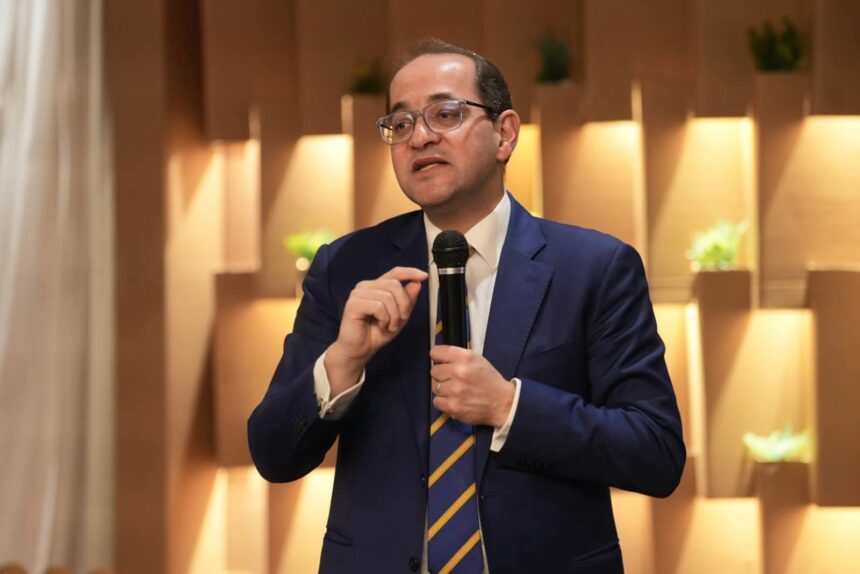
Egypt’s Minister of Finance Ahmed Kouchouk said that the Egyptian government is maintaining direct communication with investors to tackle tax, customs, and financial challenges through practical, actionable solutions. Speaking at the annual conference of the Federation of Small and Medium Enterprises Investors, which brought together entrepreneurs from across the governorates, Kouchouk praised the open dialogue with “ambitious investors” seeking to expand and grow.
“Last year, we promised the first package of tax facilitation measures, and together we delivered on that promise,” Kouchouk said, noting that the positive results confirm that “betting on the private sector always pays off.”
He explained that 120,000 taxpayers have voluntarily joined the simplified tax system. Additional financing initiatives have also been introduced to encourage further participation in this advanced and incentivised framework. Under the programme, taxpayers voluntarily submitted around 660,000 new and amended tax returns, reported business volumes amounting to EGP 1trn, and paid approximately EGP 80bn in additional taxes.
“We are proud of this valuable trust from our partners in the tax facilitation journey,” Kouchouk added. He also noted that a second package of tax facilitation measures will be presented to the House of Representatives after Eid Al-Fitr.
The Finance Minister highlighted that the government continues efforts to stimulate economic activity, expand initiatives in industry, tourism, and exports, and reduce customs clearance times to ease costs and burdens on investor partners.
Khaled Hashem, Minister of Industry, emphasised the ministry’s commitment to strengthening communication with owners of micro, small, and medium enterprises (MSMEs), describing them as a vital link between large-scale projects and micro-enterprises, and a cornerstone of the productive economy system. He noted that sustainable industrial development requires integration and coordination across all sectors.
Hashem stressed the importance of accurate data on markets, commodities, and industrial activities. The ministry is developing mechanisms to collect and analyse economic data scientifically and systematically, linking it within an integrated knowledge framework. This will allow the private sector to utilise data for investment planning and production expansion while supporting policymakers in setting industrial priorities, identifying production gaps, and targeting investments toward high-growth sectors.
He added that the availability of a precise database on production volumes, domestic demand, and export demand will help build a clear vision for industrial development, guide investments toward sectors with the greatest need and growth potential, and boost exports.
Hashem also underlined that the ministry will focus on developing productive activities in villages and rural areas to improve household incomes, create jobs, and reduce migration to major cities. Expanding productive activities in rural regions, he said, is a key pillar of balanced economic development across governorates.
Regarding exports, Hashem explained that Egypt’s upcoming strategy will prioritise increasing the local content ratio in exported products, aiming to deepen domestic manufacturing and reduce reliance on imported inputs. Strengthening feeder industries and raising the added value of Egyptian products will enhance the competitiveness of Egyptian exports in regional and international markets.
Alaa Al-Saqti, Chairperson of the federation, noted that the current phase requires coordinated efforts between all state institutions and the business community to support the national economy and expand productive sectors, thereby increasing employment rates.
Al-Saqti praised the Finance Minister’s field-oriented approach, highlighting his ability to understand and address the challenges faced by small investors. He described this as a positive model of direct communication between government and business, and expressed hope that it could be replicated across other ministries.
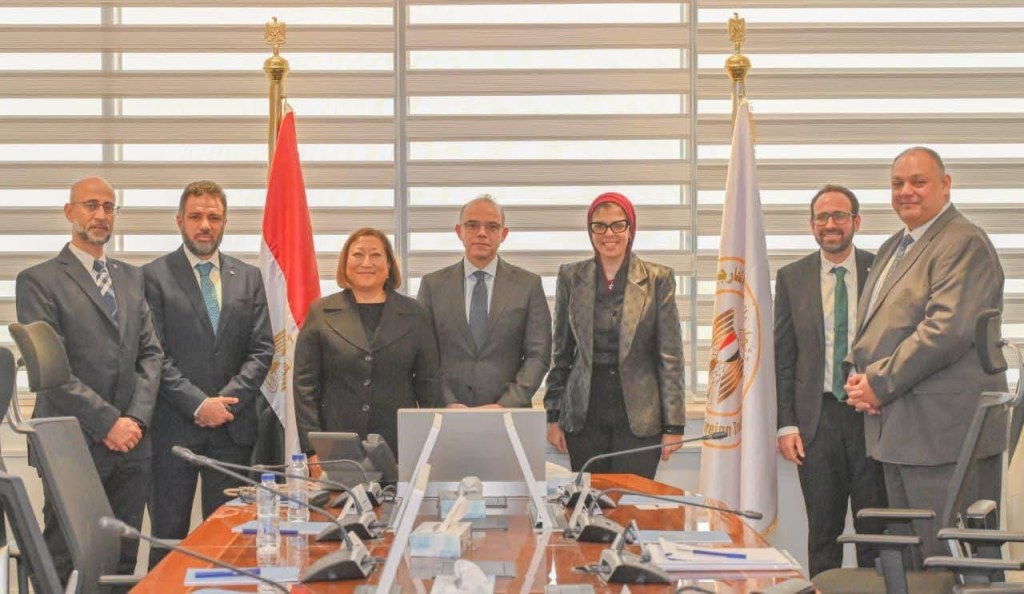
Egypt’s Minister of Investment and Foreign Trade, Mohamed Farid, held talks with Sharon Nishi, Chairperson and Managing Director of General Motors Egypt and Africa, to review the company’s current investments in Egypt and its future expansion plans.
The meeting, held on Tuesday and attended by Jehan Saleh, economic adviser to the Prime Minister, focused on the government’s efforts to localise the automotive industry, increase its contribution to GDP, and align with GM’s expansion strategy in the Egyptian market.
Farid highlighted the government’s broader agenda to localise industrial production, boost exports, attract foreign direct investment, and enhance the competitiveness of the automotive sector and its feeder industries. He underscored the strategic partnership with General Motors, which has maintained a long-standing presence in Egypt and produced more than one million vehicles locally.
The minister noted that GM’s operations have generated around 1,300 direct jobs and over 30,000 indirect jobs, reflecting sustained investor confidence in Egypt’s market and its ability to attract long-term industrial investments.
Discussions also reviewed the status of GM’s investments in Egypt, which exceed $530m, including approximately $50m allocated to robotic systems and advanced manufacturing technologies aimed at enhancing production efficiency.
Farid pointed out that local content levels in some vehicle models now exceed 60%, supporting the state’s strategy to deepen industrial localisation and increase reliance on domestically produced components.
He added that the ministry is working to develop a comprehensive export incentive framework to maximise the advantages of Egypt’s strategic geographic position as a regional production and export hub serving African and Middle Eastern markets. Improving the competitiveness of locally manufactured products, he stressed, remains central to expanding Egypt’s export footprint.
Farid reaffirmed the government’s commitment to continued coordination with General Motors, pledging full support for expanding its investments in the automotive sector and scaling up industrial exports in line with national development priorities.
For her part, Nishi described Egypt as a key pillar in the company’s long-term regional strategy, citing its strategic location and skilled workforce.
She noted that General Motors is implementing a forward-looking plan that includes launching new vehicle models aligned with evolving market dynamics, while expanding production capacity to meet domestic demand and support export growth.
Uber has partnered with Zoox to add robotaxi rides bookable on the ride-hailing giant’s smartphone application.
The partnership will launch this summer in Las Vegas, allowing riders to book rides in Zoox’s purpose-built robotaxis using Uber’s app, the two companies announced Wednesday. Rides can still be booked using Zoox’s app.
“We are excited to partner with Uber, a company that shares our vision for transforming mobility,” Zoox CEO Aicha Evans said in a statement. “This partnership is an opportunity to continue advancing the use of autonomous mobility in daily life. Through our collaboration, Zoox will provide a differentiated rider experience to those who already know and love the convenience of riding with Uber.”
Amazon-owned Zoox has been operating a free robotaxi service in Las Vegas since last fall, offering free rides to and from Resorts World, Topgolf, New York-New York and Area 15. The rides bookable on the Uber app will also be limited to Zoox’s approved sites.
Zoox plans to expand its site list this year while implementing a fee to ride the service. Zoox has deals in place with T-Mobile Arena and Sphere to add dedicated ride zones at both properties. Zoox and Uber also plan to expand their partnership, adding shared rides in Los Angeles by the middle of next year.
The partnership with Uber marks the first time Zoox has struck a deal with a third-party ride-hailing platform.
Since 2019, Zoox has been operating in Southern Nevada and are based out a 190,000-square-foot headquarters located in the southwest valley.
Zoox robotaxis are four-seater pods, with two seats on each side facing each other, with no steering wheel or pedals and have the ability to move forward and backward at 75 mph. Riders can charge their phones inside the vehicles and they can control the temperature and music from screens located within the robotaxi.
Oracle is pivoting toward cloud infrastructure, and that has proved controversial on Wall Street due to the heavy spending it requires. Can the company sway the doubters with its third-quarter results Tuesday?
Shares of Oracle
ORCL-0.92% are down 22% so far this year, and they’re off 55% from their September peak. Investor sentiment has remained subdued even as the company announced a $50 billion funding strategy that some analysts thought would remove an overhang around the amount of debt the company will need to take on this year.
Unanswered questions remain regarding Oracle’s ability to execute on AI infrastructure buildouts. Investors are also curious about the ultimate return on investment that will come from all these AI commitments, BNP Paribas global head of software research Stefan Slowinski wrote in a note Friday.
While Slowinski doesn’t expect Oracle’s earnings results to offer definitive conclusions, “we believe simply hitting [fiscal third-quarter] consensus numbers would be a good first step in rebuilding confidence that the company can consistently deliver against expectations,” he wrote. Slowinski maintained his buy rating but lowered his price target to $201 from $290.
Analysts tracked by FactSet are expecting Oracle to report $16.2 billion in sales and $1.70 in earnings per share. Remaining performance obligations, or future revenue not yet recognized, are expected to be $556 billion.
Last Friday, Bloomberg reported that negotiations for a 600-megawatt expansion at Oracle’s Abilene, Texas, data-center site were canceled due to financing challenges and OpenAI’s shifting needs. However, TD Cowen analyst Derrick Wood wrote in a Monday note that the development could reduce Oracle’s capital-expenditure needs by up to $20 billion in the next few years but not impact Oracle’s RPO, as he believed the deal hadn’t been formally signed.
Oracle has disputed these reports, saying in a statement Sunday that “recent media activity about the Abilene site are false and incorrect.”
Amid AI funding concerns, Oracle is reported to be planning thousands of job cuts as well. Meanwhile, the company is expected have put $14 billion toward capital expenditures in the third quarter, leading to negative free cash flow of $8.1 billion.
For Tuesday’s earnings report, Jefferies analyst Brent Thill is focusing on a few key bogeys, or performance benchmarks. These include 86% growth for the company’s Oracle Cloud Infrastructure division, 42% operating margins and $18 billion in net new RPO. However, Thill expects Oracle’s margins to continue declining in the short term as the company’s business becomes more focused on AI infrastructure. He anticipates adjusted operating margins to trough at roughly 33% in fiscal year 2028.
As geopolitical fragmentation, AI acceleration and infrastructure pressure reshape global mobility, senior leaders across travel, finance, technology and government are consolidating strategic engagement through the Global Resilience Network (GRN). The Network, now operating across Europe, Asia, the Middle East and the Americas, is strengthening executive-level coordination at a time when industry leaders are questioning whether traditional forums alone can deliver the coherence required for the next phase of global travel growth.
This renewed emphasis on structural resilience, reflected in recent global industry discussions, including the observance of UN Global Tourism Resilience Day on 17 February, underscores the growing recognition that preparedness must be matched by coordinated action across sectors. While dialogue across the sector has increased, industry stakeholders acknowledge that volume of conversation has not necessarily translated into alignment or actionable coordination. GRN has been structured as a curated, cross-sector convergence platform designed specifically to address that gap.
Rather than functioning as a conference organiser or membership association, the Network is positioned as a selective, invitation-led leadership infrastructure, convening decision-makers whose collective influence shapes global mobility, including aviation, hospitality, destinations, financial services, infrastructure, energy, technology and investment. The initiative builds on more than a decade of structured engagement with senior industry figures, reflecting consistent demand for more focused, outcome-driven formats that move beyond representation toward responsibility.
The Network has a distinguished panel of international experts drawn from government, tourism, technology and destination development, names include; Ghada Shalaby, former Deputy Minister of Tourism, Arab Republic of Egypt; Egyptian Hotel Association, Christian Mantei, President, Phase 3 Conseil formerly with Montefiore Investment, ATOUT France, IGESA and ATREAM, Alex MacEwan, International Investment and Strategy Advisor; Head of Investment Companies, Capital Access Group, Paras Loomba, CEO and Founder, GHE (Global Himalayan Expeditions), Claude Blanc, Sr. Advisor, travel and tourism; formerly Amadeus, RXGlobal and Rajan Datar, Host and Journalist, BBC.
Laurie Myers, Founding Strategist commented “The global system is not suffering from a lack of dialogue; it is suffering from a lack of coherence. Travel does not operate in isolation; it is shaped by financial systems, infrastructure decisions, technological platforms and geopolitical realities. GRN exists to enable alignment between those with the authority and capacity to shape outcomes.” The Network reflects a growing recognition that resilience is systemic, not sector specific. In an era where fragmentation has become the default condition, coherence is emerging as the new leadership imperative, and GRN exists to help enable it. https://www.breakingtravelnews.com/news/article/global-travel-leaders-formalise-cross-sector-coordination-through-the-globa/




 2026NowNews