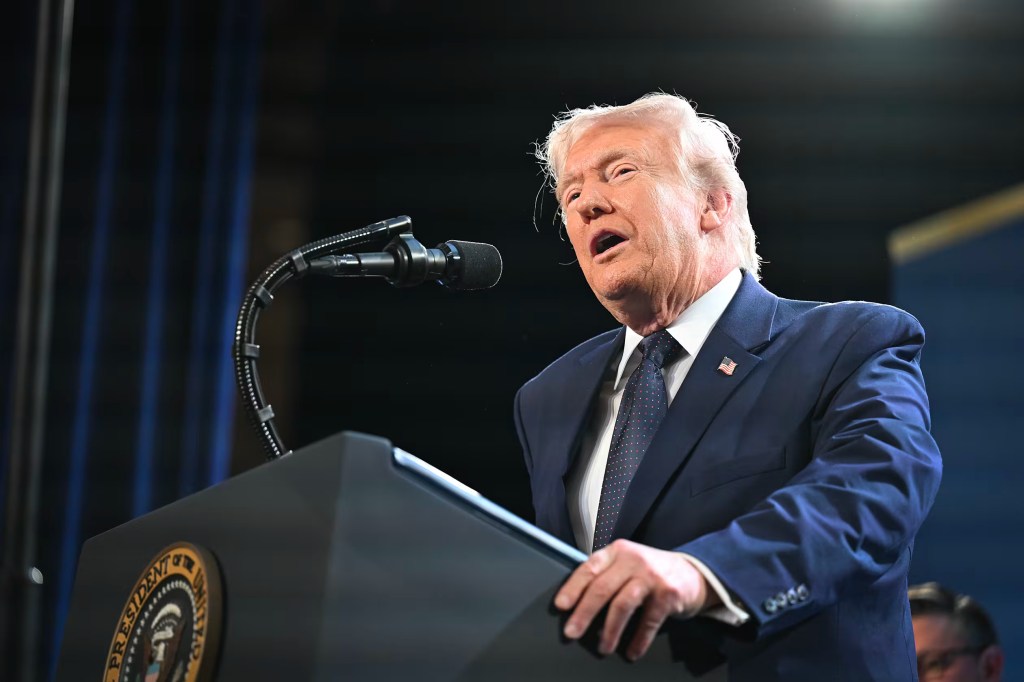
President Donald Trump said the U.S. is waiving oil-related sanctions on certain countries in an effort to ease crude prices, as he estimated the war with Iran would end “very soon.”
“So in some countries, we’re going to take those sanctions off until this straightens out,” Trump said Monday in remarks to reporters in Doral, Fla.
retreated from highs as investors priced in the possibility of a coordinated emergency release of oil reserves. Oil futures were falling another 10% on Monday night.
Trump didn’t name countries on which his administration is mulling the reduction of sanctions. Earlier Monday, Reuters reported that the White House was weighing further easing of sanctions on Russia. The U.S. has allowed India to buy Russian oil without being penalized by the Trump administration. Trump spoke with Russian leader Vladimir Putin on Monday.
Trump predicted a “short-term excursion” in Iran but also suggested U.S. involvement there would continue.
“We could go further, and we’re going to go further,” he said.
Earlier Monday, Trump told a CBS reporter that the conflict with Iran could end soon, saying he thought the war was “very complete, pretty much.” He said Iran has no navy, communications or air force.
And there were signs Monday that the wealthy countries that make up the Group of Seven were discussing an emergency release of crude reserves.
U.S. and global benchmark prices both climbed to nearly $120 a barrel at their peaks in overnight trading, before retreating from those highs as investors priced in the potential G-7 action.
The G-7 development helped ease concerns over disruptions to the global flow of oil resulting from the Iran conflict. Energy ministers from the group are planning a virtual meeting Tuesday to discuss a possible release of oil reserves to address supply disruptions triggered by the Iran war, sources told CNBC.
Oracle is pivoting toward cloud infrastructure, and that has proved controversial on Wall Street due to the heavy spending it requires. Can the company sway the doubters with its third-quarter results Tuesday?
Shares of Oracle
ORCL-0.92% are down 22% so far this year, and they’re off 55% from their September peak. Investor sentiment has remained subdued even as the company announced a $50 billion funding strategy that some analysts thought would remove an overhang around the amount of debt the company will need to take on this year.
Unanswered questions remain regarding Oracle’s ability to execute on AI infrastructure buildouts. Investors are also curious about the ultimate return on investment that will come from all these AI commitments, BNP Paribas global head of software research Stefan Slowinski wrote in a note Friday.
While Slowinski doesn’t expect Oracle’s earnings results to offer definitive conclusions, “we believe simply hitting [fiscal third-quarter] consensus numbers would be a good first step in rebuilding confidence that the company can consistently deliver against expectations,” he wrote. Slowinski maintained his buy rating but lowered his price target to $201 from $290.
Analysts tracked by FactSet are expecting Oracle to report $16.2 billion in sales and $1.70 in earnings per share. Remaining performance obligations, or future revenue not yet recognized, are expected to be $556 billion.
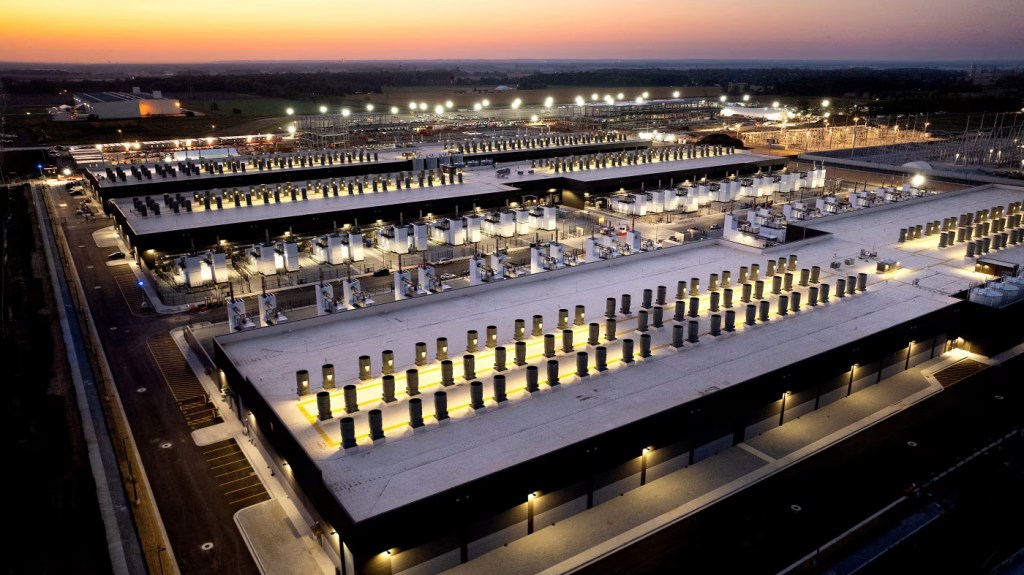
Last Friday, Bloomberg reported that negotiations for a 600-megawatt expansion at Oracle’s Abilene, Texas, data-center site were canceled due to financing challenges and OpenAI’s shifting needs. However, TD Cowen analyst Derrick Wood wrote in a Monday note that the development could reduce Oracle’s capital-expenditure needs by up to $20 billion in the next few years but not impact Oracle’s RPO, as he believed the deal hadn’t been formally signed.
Oracle has disputed these reports, saying in a statement Sunday that “recent media activity about the Abilene site are false and incorrect.”
Amid AI funding concerns, Oracle is reported to be planning thousands of job cuts as well. Meanwhile, the company is expected have put $14 billion toward capital expenditures in the third quarter, leading to negative free cash flow of $8.1 billion.
For Tuesday’s earnings report, Jefferies analyst Brent Thill is focusing on a few key bogeys, or performance benchmarks. These include 86% growth for the company’s Oracle Cloud Infrastructure division, 42% operating margins and $18 billion in net new RPO. However, Thill expects Oracle’s margins to continue declining in the short term as the company’s business becomes more focused on AI infrastructure. He anticipates adjusted operating margins to trough at roughly 33% in fiscal year 2028.
For new investors, not only is it hard to choose which stocks, bonds and other assets to put your money in, but it’s also challenging to figure out what app or site might be best for you to begin the process. While investing sites and apps can be a great place to find information, research stocks and ETFs, and even manage your investments, there are myriad options.
So we asked 10 wealth experts: what are the best sites or apps that actually help first-time investors the most? And, what features should you be looking for in one of these platforms?
Fidelity Investments, says Shane Cummings, CFP and director of technology/cybersecurity at Halbert Hargrove.
“I would generally recommend the Fidelity Investments platform for new investors starting off. The user interface is well-designed and intuitive to use. I think it offers a lot of functionality without being too overwhelming. They also highly value account security and offer a great dashboard for checking your security settings, which I think is very important in this day and age.
I also like that Fidelity will allow you to make trades in dollar quantities instead of only share quantities, which is a great feature for investors getting started. If you have only $50 or $100 to invest and want to buy shares of a specific stock/company, you can purchase fractional shares this way, so you can still participate in ownership of your desired stock(s) even if the current share price is greater than the amount you’re able to invest.”
M1 Finance, Fidelity, Schwab and Vanguard, says Michael Boggiano, registered investment adviser, managing partner and co-founder at Wealthcare Financial.
“For any first-time investors, I typically recommend platforms that emphasize simplicity, education and low costs. M1 Finance as a good option for those who like a bit more control over their portfolio construction while still having some automation features. Apps like Fidelity, Schwab, and Vanguard are strong starting points because they combine easy-to-use interfaces with robust educational resources and long-term investing tools.
For clients who prefer a more guided approach, robo-advisors such as Betterment or Wealthfront can also be useful. These platforms help new investors get started quickly by automatically building diversified portfolios and rebalancing them over time, which removes some of the guesswork and emotional decision-making. Ultimately, the best platform is one that encourages consistency and long-term investing rather than frequent trading.”
“For people looking to track expenses, net worth, savings/investing goals and overall budget, I really like what Monarch Money has to offer. Monarch money is one of those all-in-one apps that can help provide a clear holistic view of someone’s financial health and help them understand how they got there and how they can work to take the next step. SoFi Invest is a great all in one account if someone is looking to combine banking and investing in the same app …
… I would caution any first time investor to be very careful when it comes to options and margin and I would recommend avoiding anything that is pushing options/margin unless you really mean to get involved with this.”
Schwab, says Chelsea Kiehler, investment adviser and managing principal at Sequent Planning.
“Schwab is pretty user friendly and easy to learn while offering free trades. They also provide access to general market information.
Rather than going it alone, employees should take advantage of free workplace resources such as Employee Assistance Programs (EAPs), financial wellness programs, coaching and access to financial advisers. These benefits can provide objective guidance, help investors avoid emotional decision-making, like buying high during market excitement, and support a disciplined, long-term strategy aligned with their broader financial plan.”
Fidelity, Vanguard or Schwab, says Michael Foguth, founder and president at Foguth Financial Group.
“When clients are just getting started with investing, I usually point them toward platforms that make the process simple without oversimplifying the decisions. Apps like Fidelity, Vanguard or Schwab tend to be strong options because they combine low costs with solid educational resources. For beginners, that combination is critical — you want a platform that encourages long-term investing rather than constant trading. Some newer apps can make investing feel like a game, which may be exciting at first but can lead to poor habits if people start chasing short-term gains.
A good investing platform should offer low fees, access to diversified investments like index funds or ETFs, and educational tools that help people understand what they’re doing with their money.”
Betterment, Fidelity, Vanguard, Wealthfront and Schwab, says Kyle Mostransky, financial adviser and owner at Mostransky & Associates, LLC.
“Not one app/platform is perfect, however these do a great job for new investors: Fidelity, Vanguard, Betterment, Wealthfront and Schwab … They prioritize simplicity, education tools and relatively low cost when first starting out choosing an investment app or platform.
Also, it helps clients that do not have an adviser to help teach risk tolerance, diversification, tax implications, etc. A good app/platform can help educate them on those topics. We want new investors to build confidence and engagement early on and make sure they know why they are doing something and not just the ‘how to do it.’ Simplicity reduces decision fatigue and minimizes behavioral mistakes to help with long term goal-based investment.”
Robo advisers, says Brian Matter, CFP, principal and owner at Creative Capital Management Investments.
“For first-time investors, I highly recommend low-cost, easy-to-use platforms that make it simple to buy diversified investments (like broad-market index ETFs) and focus on automating good habits over gamification. A few common examples include large, well-established brokerages as well as reputable robo-advisors. The ‘best’ choice depends on what the investor needs most.
If simplicity is the priority then a robo-advisor might be a good option because it handles portfolio construction, rebalancing, and ongoing maintenance automatically. As an adviser I don’t always agree with some of the allocations that are put together but they will be easy to use and get someone started. If the investor wants to learn hands-on then a major brokerage with strong education tools, access to fractional shares, and easy recurring dollar-cost averaging investing can be a good fit.”
Vanguard, Fidelity, Betterment or Wealthfront, says Josh Katz, CPA and founder of Universal Tax Professionals.
“For most beginners, I tell them to start with Vanguard or Fidelity because the fund options are solid, fees are low, and the platforms aren’t trying to gamify investing with confusing features. Vanguard’s interface isn’t flashy but that’s actually good for new investors who need to just buy index funds and leave them alone.
Fidelity’s got a better mobile app and customer service if you need hand-holding. For clients who want more guidance, I’ve seen good results with Betterment or Wealthfront for automated investing, though you’re paying a small management fee for something you could do yourself with a little research. I stay away from recommending Robinhood or apps that encourage day trading because new investors don’t need that temptation.”
For those just looking to do some research
If you’re just looking to do research, pros also have some picks. “I like to introduce Morningstar to students so the students have a better understanding of how investment funds, such as exchange-traded funds and mutual funds, are evaluated. Morningstar’s tools allow for easy attribution analysis on size, style, geographical location, industry, sector, etc. I also like to introduce students to Barchart. Barchart provides easy-to-use and understandable information on equities,” says Larissa Adamiec, associate clinical professor of finance at Purdue University.
And take a look at Bogleheads.org, says Michael Ryan, retired financial planner and personal finance writer. “Not a brokerage. But another free, community-driven forum built around John Bogle’s low-cost index philosophy. The wiki covers everything from choosing your first fund to tax-loss harvesting. No ads, no affiliate links, no one selling anything. Signal-to-noise ratio crushes Reddit. I’ve pointed hundreds of clients there over decades.” https://www.marketwatch.com/picks/10-financial-advisers-and-money-pros-on-the-best-investing-apps-now-ac4de9ba?mod=newsviewer_click
VIENNA-The European Central Bank should be prepared to quickly move its key interest rate in either direction if some of the potential threats to the eurozone economy arising from a fresh increase in uncertainty come to pass, Austria’s central bank governor said.
The ECB has kept rates on hold since June last year, with annual inflation having hovered close to the bank’s 2% medium-term target for much of 2025. Toward the end of last year, policymakers were seeing a reduction in uncertainty about trade that would be positive for the eurozone economy, while investors were betting that the next change in the key rate would be a raise.
But in an interview with The Wall Street Journal, Martin Kocher said a fresh increase in uncertainty since the start of the year makes it possible that the key rate will be lowered again, and also possible that the next move will be an increase.
“When you are at the end, or very close to the end, of this easing cycle that we have been following, then it’s always difficult to say what happens next,” said Kocher, a voting member of the ECB’s governing board. “In times where we really have high levels of uncertainty, it’s important to be in a situation where you can act quickly.”
The revival in uncertainty is largely due to developments in the U.S. In January, President Trump threatened to annex Greenland, which is a part of Denmark. Last month, the U.S. Supreme Court declared Trump’s country-specific tariffs to be illegal. While the administration works on new country-specific tariffs under a different law, a blanket 10% tariff has been imposed.
The attacks by the U.S. and Israel on Iran, and its response, have further raised the level of uncertainty for policymakers.
“At this stage, it is definitely too early to quantify any concrete impact of the unfolding events on euro area inflation or growth,” Kocher said.
Disruptions to oil markets or shipping through the Strait of Hormuz could increase costs and therefore inflation, but heightened tensions could weigh on economic activity, he said.
But in confronting that uncertainty, Kocher said it is important to respond to outcomes, rather than possibilities.
“There is a high option value of being able to act if and only if some of the risks of the uncertainties manifest themselves,” he said. “Pre-empting uncertain outcomes with monetary-policy decisions is complicated and perhaps dangerous.”
Attacks by the U.S. and Israel on Iran, and that country’s response, make the outlook for the global economy more uncertain, but it is too early to judge the impact, the International Monetary Fund said Tuesday.
In a statement, the Fund said it is closely monitoring developments in the Middle East, where the situation is “highly fluid.”
“It is too early to assess the economic impact on the region and the global economy,” the IMF said. “That impact will depend on the extent and duration of the conflict.”
President Trump, speaking Monday at the White House, said the attacks on Iran could last four to five more weeks.
The Fund said it will provide a comprehensive assessment in new forecasts that are due to be released next month.
In January, the Fund raised its growth forecast for the global economy this year, but warned activity could falter if trade barriers rise again and geopolitical conflicts intensify.
The Fund then expected global output to grow by 3.3%, having previously forecast an expansion of 3%.
In the days after the start of the conflict, energy prices have surged, reflecting the effective closure of the Strait of Hormuz and the suspension of operations at some oil-and-gas facilities in the region.
That could lead to a revival in inflation and a slowdown in growth for energy-importing countries. Government bond yields around the world have also risen and, if sustained, that would lead to higher borrowing costs for households and governments.
“So far, we have observed disruptions to trade and economic activity, surges in energy prices, and volatility in financial markets,” the IMF said.
Eurozone inflation picked up unexpectedly in February, and could accelerate further if the rise in energy prices that followed U.S. and Israeli attacks on Iran is sustained.
Consumer prices in the 21-member currency area were 1.9% higher than a year earlier compared with a 1.7% rise in January, the European Union’s statistics agency Eurostat said Tuesday. That was above a consensus of economists polled by The Wall Street Journal, which expected the inflation rate to remain unchanged on month.
The ECB targets an inflation rate of 2%, and forecasts price growth to average 1.9% in the first quarter.
The bank has said it expects consumer prices to average 1.9% this year, and to fall a little further in 2027, before rebounding to target in 2028. At its latest meeting in early February, the ECB voted to keep its key interest rate unchanged at 2%, reiterating that policy remains in a “good place.”
But higher energy prices following the attacks on Iran may push inflation even higher. The price of Brent crude oil, the international benchmark, topped $80 a barrel on Tuesday, and analysts have said prices could hit $100 if the conflict is prolonged. European natural-gas prices have risen more than 75% in the last two days. The price of oil and gas declined over 2025, but began picking up at the start of this year following multiple geopolitical shocks.
However, fresh geopolitical uncertainty could weaken confidence and damp growth, thereby cooling inflation. It could take time before policymakers can discern which of those effects are dominant, and respond.
“Should disruptions to oil markets or key transport routes materialize and become more permanent, this could increase costs and thereby influence inflation in Europe,” said Martin Kocher, head of Austria’s central bank, in an interview. “At the same time, heightened geopolitical tensions can weigh on investment and economic activity.”
While Europe isn’t highly reliant on energy resources from the Persian Gulf region, an increase in global prices for oil and natural gas would ultimately feed through to prices in Europe, regardless of limited physical imports.
Restrictions on gas imports are a particular concern for the bloc, as storage levels currently remain low. On Monday, a drone attack on QatarEnergy’s Ras Laffan gas complex caused European prices to soar.
The European Central Bank has previously said a 14% increase in oil prices could drive an increase in the inflation rate of half of a percentage point. Commerzbank estimates that a prolonged war in the Middle East could raise eurozone price growth by a full percentage point.
Eurozone energy prices, which are heavily influenced by international markets, slipped 3.2% in February compared with a 4% fall in January. Services inflation edged up to 3.4%.
Higher energy prices could prompt the ECB to consider raising interest rates, Point72 economist Soeren Radde said in a note. “In practice, the ECB will be wary of mistaking a very persistent energy price shock for a transient shock.”
But the ECB shouldn’t rush to draw comparisons with a spike in energy prices in 2022, said Guntram Wolff, professor of economics at the Universite Libre de Bruxelles. Russia’s war on Ukraine hit Europe particularly hard due to reduced supplies of natural gas and prolonged uncertainty over sanctions, which don’t apply in the case of Iran, he said.
“For now it’s a temporary shock, and as a central bank you want to look through this. Even if it’s a permanent shock, in the long term it will shuffle consumption away from other areas of demand towards energy use, offering some counterbalancing effect,” Wolff said.
In response to the 2022 spike in energy prices, the ECB raised its key interest rate by four-and-a-half percentage points between July 2022 and September of the following year. Inflation peaked in late 2022, and spent much of last year hovering around the 2% target.
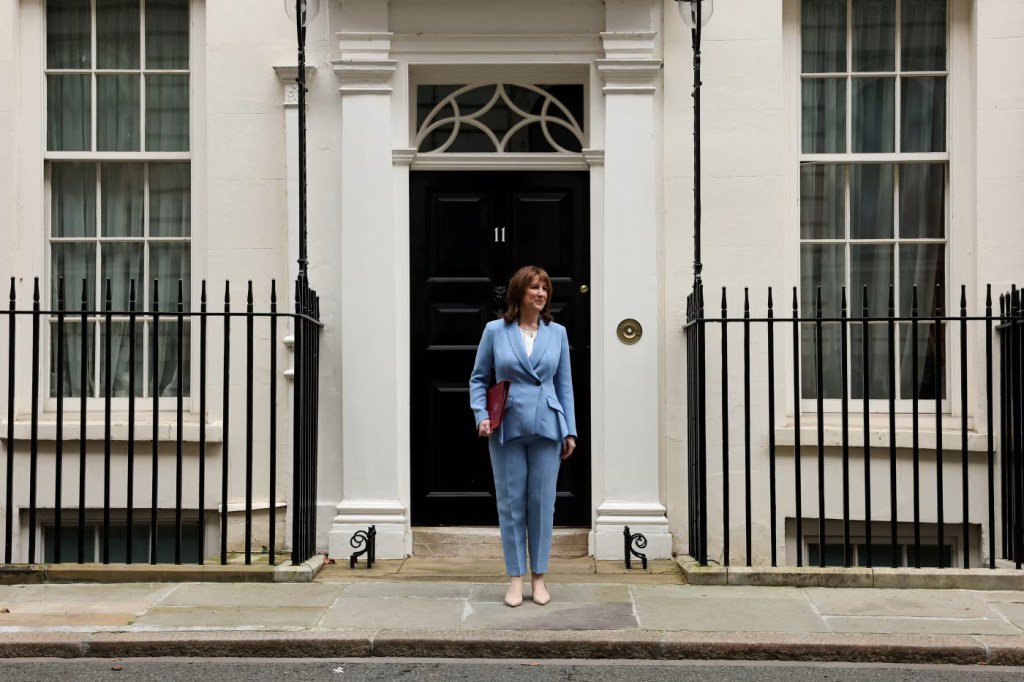
The U.K. government is on track to cut borrowing and reduce its debts, although the attacks on Iran by the U.S. and Israel have made the outlook more uncertain, Treasury Chief Rachel Reeves said Tuesday.
In the first of two annual presentations to lawmakers, Reeves cited new forecasts from the Office for Budget Responsibility that estimate the budget deficit for the fiscal year ending early next month will be 4.3% of annual economic output, the smallest gap between expenditures and revenues since the outbreak of the Covid-19 pandemic.
“The forecasts today confirm that the choices this government has made are the right ones,” Reeves said. “Stability in our public finances, interest rates and inflation falling.”
However, Reeves said the economic outlook has become “yet more uncertain” after the attacks on Iran and its response.
“It is incumbent on me and on this government to chart a course through that uncertainty, to secure our economy against shocks and protect families from the turbulence that we see beyond our borders,” she told lawmakers.
The conflict has raised energy prices, potentially slowing U.K. growth and pushing consumer prices and borrowing costs higher.
“If it persists, it will raise household bills and business costs in the months ahead, putting renewed upward pressure on inflation, and potentially interest rates,” said David Aikman, director of the National Institute for Economic and Social Research.
Even before the attacks, the outlook for the U.K. economy had weakened. The OBR lowered its growth forecast for 2026 to 1.1% from 1.4%.
The OBR’s estimate for this year’s budget deficit is lower than the 4.5% it saw in November. It expects the deficit to fall to 3.6% of economic output in the coming fiscal year, and 2.9% in the following period.
The OBR’s new forecasts indicate that the government is sticking to its self-imposed budget rules, which require that day-to-day spending is paid for out of tax revenues, rather than borrowing, by the fiscal year ending March 2030.
The budget watchdog estimated that in that year, the current budget will be in surplus by 23.6 billion pounds.
The budget rules also require that the stock of debt—measured as public sector net financial liabilities—should be falling by the fiscal year ending in 2030. The OBR estimated debt would be equivalent to 82.2% of economic output in that year, down from 82.9%.
Better news on the deficit had helped lower government bond yields following the November budget. That was helped by expectations that the Bank of England would lower its key interest in the first half of this year.
Over time, lower yields would have translated into reduced interest bills. But much of that progress has been unwound since the attacks on Iran began.
The BOE had expected inflation to settle at its target from April, but higher energy prices raise doubts about that projection. Policymakers may become more cautious, and reluctant to lower borrowing costs until they can be more certain of the likely impact of the new shock.
There is therefore a risk that economic growth and government tax revenues will be lower than the OBR expects, while the interest bill will be higher.
Swiss inflation was unchanged in February close to zero, a worry for the country’s central bank after it voiced increased willingness to intervene in foreign-exchange markets to halt recent gains in the franc.
Consumer prices were up 0.1% compared with February last year, the same rise as in January, Switzerland’s statistics agency said Wednesday. Swiss inflation was last negative in May.
The Swiss National Bank has struggled to limit the appreciation of the franc over the last year as investors have sought a safe haven from the upheaval caused by President Trump’s tariff hikes and innovations in foreign policy. The attacks on Iran over the weekend pushed the franc to its highest level against the euro in more than a decade on Monday.
A stronger franc lowers the domestic prices of imported goods, while also damping demand for Swiss goods abroad, which also cools inflation. The Swiss economy barely grew in the second half of last year after a significant rise in U.S. tariffs hit the country’s exports, which include luxury watches and chemicals.
The SNB has an inflation target of more than zero but below 2%. Central bankers fear periods of deflation, in which falling prices lead businesses and households to hold back on spending in anticipation of securing better deals in the future. This then weakens activity and prices in what can become a vicious circle.
The SNB has limited options to halt the appreciation of the franc. The central bank’s key interest rate is already at zero, and Chairman Martin Schlegel has long stressed there is a high bar to lowering the key rate below zero, underlining the negative impact on savers and the country’s banks.
The central bank could also sell francs to weaken the currency, thereby helping to boost the inflation rate.
In an unusual announcement, the SNB said Monday that its willingness to sell francs has increased.
“We are prepared to intervene in the foreign-exchange market to counter a rapid and excessive appreciation of the Swiss franc, which jeopardizes price stability in Switzerland,” the bank said.
The franc fell back slightly against other currencies after the announcement. However, it did little to dent the gain of more than 14% against the dollar in the past year.
“Such a warning from the SNB is rather rare,” Commerzbank analyst Michael Pfister said in a note to clients.
“For the time being, it is likely that officials have ensured the market will only test stronger franc levels very cautiously, even amid rising geopolitical risks,” he added.
The move could put Switzerland in the crosshairs of the U.S. Treasury, which put the Alpine nation on its watch list for currency manipulation.
Switzerland is due to publish its foreign-currency reserves for February on Friday.
The jump in prices of oil and gas prompted by the conflict in the Middle East could stoke an increase in inflation in the months ahead. More than 70% of energy consumed in Switzerland is imported, according to a 2025 study by the Swiss Energy Foundation.
“A stable currency and potentially higher energy prices, at least in the near term, largely eliminate the risk of the Swiss economy slipping into deflation over the coming quarters,” said Ankita Amajuri, Europe economist at Pantheon Macroeconomics in a note.
Imported-product prices were down 1.6% in February compared with the same month of last year, while domestic inflation was 0.6%, Wednesday’s data showed.
Governments in rich countries are set to sell a record amount of bonds this year in an increasingly risky environment, while a small number of companies plan to borrow heavily to fund the “enormous” cost of building AI capacity, the Organization for Economic Cooperation and Development said Wednesday.
In its annual report on debt issuance, the OECD said rich-country governments led by the U.S. will have to sell $14.5 trillion in bonds just to replace securities that are maturing, a process known as refinancing. New borrowing will likely bring total issuance to around $18 trillion, an increase of $1 trillion from last year, and a new record.
The increase in refinancing needs partly reflects a shift to selling bonds with shorter maturities, a response to the increased cost of selling longer-dated securities as borrowing surged during the Covid-19 pandemic and in subsequent years.
However, that shift to shorter maturities brings risks. The more often outstanding bonds need to be replaced with new issues, the more vulnerable the government is to a shock that leads investors to temporarily withdraw or demand sharply higher compensation to lend.
“The risk of refinancing may be high, especially in a geopolitical context with a lot of variability,” said Carmine Di Noia, the OECD’s director for financial affairs.
Yields on government bonds have risen sharply since the U.S. and Israel attacked Iran, a move that would increase the cost of refinancing if sustained.
According to the OECD’s figures, the U.S. faces the largest refinancing requirement among its membership, with bond sales equivalent to 31% of gross domestic product in 2025. Japan had the next highest requirement, at 25%, while Italy had the largest in Europe at 16.8%.
The U.S. accounts for an increasing share of total refinancing needs. It was responsible for 70% in 2025, up from 57% in 2020 and just 35% in 2007, the year before the global financial crisis struck.
New borrowing will likely bring total issuance to $18.3 trillion, an increase of more than $1 trillion from last year, and a new record. Governments from developing economies are expected to sell $3.6 trillion in bonds, up from $3.4 trillion last year.
Despite the rapid rise in sales amid increased trade disputes and international conflict, bond markets are “showing few signs of strain,” Di Noia said.
But that could change.
“The resilience debt markets have shown in the face of major pressures should not be taken for granted,” he said. “It rests on a foundation of rigorous monetary policy frameworks, serious commitments to sound fiscal policy, and trust in the integrity of the institutions governing these markets.”
The OECD also expects bond sales by businesses to reach a record high of $6.9 trillion this year, up from $6.8 trillion last year and $4.8 trillion in 2019.
“Given the scale of capital expenditure required to finance the expansion of AI, corporate borrowing needs are expected to continue increasing substantially,” the Paris-based research body said.
That surge in AI-related borrowing could take the corporate bond markets into uncharted territory, with degrees of concentration similar to those seen in equity markets over recent years.
The OECD estimates that nine “hyperscalers” alone are planning capital expenditures of $4.1 trillion between 2026 and 2030, or 36% more than total capital expenditure by all non-financial U.S. companies in 2025.
If half of those investments were financed through bond markets, the OECD calculates the nine would account for issuance of bonds equivalent to 15% of average annual sales by all non-financial businesses globally in the years 2020 to 2025.
“These developments may be setting corporate debt markets on course to become more equity-like,” the OECD said. “Combined with the enormous AI-related financing needs of other sectors, from energy providers to construction companies, AI financing is set to transform these markets.”
The eurozone unemployment rate fell to a new record low in January, as the bloc continued to show resilience in the face of global uncertainty.
Unemployment in the currency area fell to 6.1% from 6.2% in December, the European Union’s statistics agency Eurostat said Wednesday.
“Overall, these are robust data which will add to the looming hawkish shift at the ECB as inflation risks now seem to be shifting to the upside,” said Claus Vistesen, chief eurozone economist at Pantheon Macroeconomics.
Across the bloc’s major economies, the decline was driven mainly by falling joblessness in Spain and Italy, he said.
Excluding Bulgaria, which joined the eurozone at the start of 2026, the unemployment rate stood at 6.2%.
“Falling unemployment in Bulgaria of all places…is now helping eurozone joblessness lower,” Vistesen said.
The currency area’s jobless rate is projected to remain relatively stable this year. However, a prolonged attack on Iran by the U.S. and Israel could eventually feed through to employment, as higher energy prices put pressure on businesses.
The figures follow the publication of S&P Global’s purchasing managers’ eurozone survey in late February, which showed companies are reluctant to hire new employees.
In Germany, the bloc’s largest economy, the number of unemployed people fell to just above 3 million in February, with the adjusted rate remaining at 6.3%.




 2026NowNews