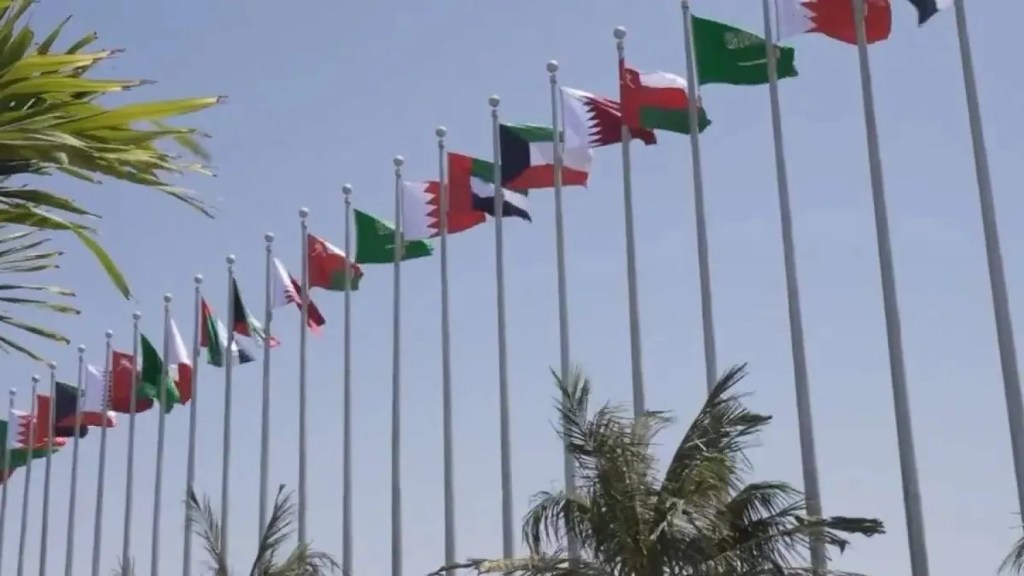
Gulf leaders meeting in Jeddah this week urged faster progress on joint projects and deeper military integration, seeking to reinforce collective security and economic coordination amid heightened regional tensions.
In a statement after the consultative summit on Tuesday, GCC Secretary-General Jasem Albudaiwi said leaders called for accelerating completion of requirements to link all shared Gulf projects, including transport and logistics. They stressed speeding up implementation of the Gulf railway, advancing electricity interconnection, and taking prompt steps toward oil and gas pipeline and water-link projects.
The statement also pointed to studying strategic Gulf stockpiles, while emphasizing intensified military integration and faster completion of a joint early warning system against ballistic missiles.
The direct wording – repeating terms such as “accelerate” and “urgency” – reflected a push for concrete outcomes and highlighted Saudi Arabia’s initiative in convening the summit amid complex regional conditions.
Qatar’s Emir, Sheikh Tamim bin Hamad Al Thani, said the meeting reflected Gulf unity. “Our consultative summit today in Jeddah embodies a unified Gulf position toward current developments and the need to intensify coordination and consultation,” he stated, adding that this would strengthen diplomatic efforts, safeguard regional security and stability, and support development and prosperity.
Extending Gulf leadership efforts
Abdulaziz Sager, chairman of the Gulf Research Center, told Asharq Al-Awsat that the summit was convened in response to conditions facing the Gulf region following the US-Israeli-Iranian war, aiming to coordinate GCC positions and contain its repercussions.
The goal is to enhance efforts to address this crisis and its consequences – security, economic and otherwise – to stabilize the region, safeguard GCC interests and strengthen collective security, he underlined.
Sager added that the summit builds on efforts led by Saudi Crown Prince Mohammed bin Salman and other Gulf leaders, within the broader vision of King Salman bin Abdulaziz to strengthen joint Gulf action, deepen economic unity, and develop defense and security systems toward more sustainable integration.
He revealed that these discussions also addressed reinforcing Gulf unity to better manage current challenges and anticipate future crises.
Toward independent Gulf decision-making
Sager said the summit is expected to build on the GCC success in confronting Iranian missile and drone attacks, using that experience to develop a comprehensive defense strategy, which would focus on modern armament suited to evolving warfare, training, and external defense partnerships, while reinforcing self-reliance.
Leaders reaffirmed the right of GCC states to self-defense, individually or collectively, under Article 51 of the United Nations Charter, and to take all measures to protect sovereignty, security and stability. They stressed full solidarity among member states and that their security is indivisible, with any attack on one considered an attack on all, in line with the joint defense agreement.
Albudaiwi said leaders praised the “courage and high readiness” of GCC armed forces in defending against Iranian attacks, noting their ability to intercept missiles and drones with professionalism and efficiency while safeguarding national assets.
Alternative routes on the agenda
Sager noted that developing alternative corridors to secure energy supply chains will likely be a key focus in the coming period, reflected in leaders’ directives to move ahead with pipeline projects and transport infrastructure.
Political analyst Ahmed Alibrahim agreed, saying the summit statement underscored Saudi Arabia’s role in securing supply chains during the crisis and working on alternative energy routes, including through the East-West pipeline, as part of addressing risks linked to the Strait of Hormuz.
He described the statement as unusually direct. “This is one of the rare times we see a clear and explicit communiqué with firm directives, especially regarding future requirements and open-ended scenarios,” he said, citing uncertainties including potential setbacks in US-Iran negotiations or other serious developments.
For his part, political analyst Mohammed Al-Dossary believes that the importance of the GCC lies in its ability to navigate many crises, including the Iraq-Iran War and Iraq’s occupation of Kuwait.
He stressed that the collective consciousness of Gulf citizens recognizes the importance of unifying the Gulf stance to overcome crises, including the current one and the implications of the Strait of Hormuz closure. https://english.aawsat.com/gulf/5268084-how-did-jeddah-summit-support-joint-gulf-action
 2026NowNews